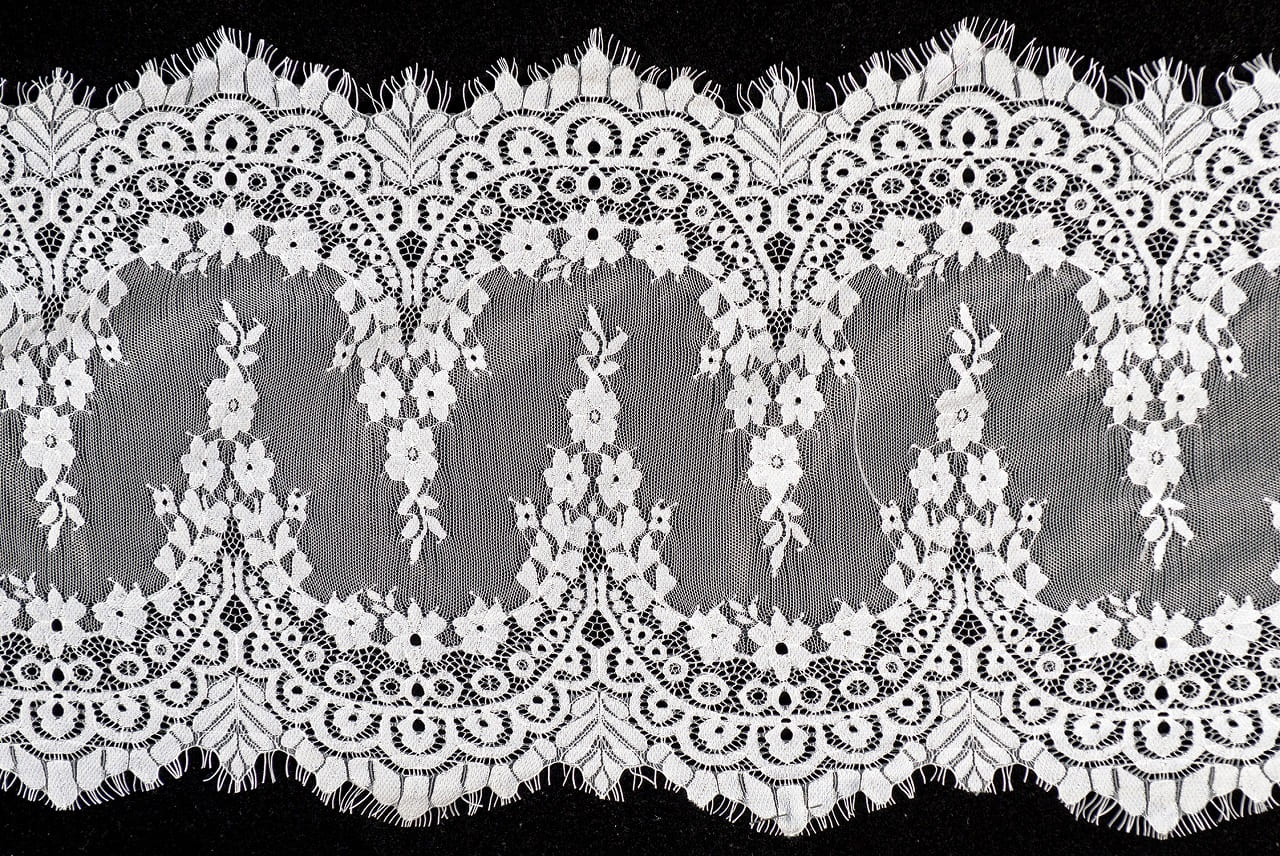
Guipure looks simple from the outside — a dense lace with motifs, pinned and stitched on a sewing machine. In reality it is one of the most demanding fabrics in any bridal atelier. It frays, stretches unevenly along the warp and weft, melts at high iron temperatures and loses colour with the wrong wash. This guide covers everything about working with guipure: cutting, sewing, ironing, washing, mistakes and how to avoid them. Unlike general guipure articles, this one is for people who actually handle the fabric.
Preparing to cut
Before cutting, guipure must be pre-shrunk (washed in cool water and dried flat) so that shrinkage will not ruin the finished gown. Lay it out with the motif in mind — large flowers on the bodice, small ones on the skirt. Cut piece by piece, on a hard surface, with very sharp shears.
8 sewing techniques for guipure
1. Sewing machine: fine needle, small stitch
Needle 70/80 (a thicker needle leaves holes in the fine net). Stitch length 2–2.5 mm. A narrow zigzag — 1 mm — for stretchy areas. On large motifs guipure stretches, so the presser foot pressure should be light.
2. Lining is mandatory
Chantilly or tulle under guipure is the bare minimum. Satin, silk or lining fabric in matching tone is the optimum. Without a lining, guipure looks "naked" and deforms under the pressure of the body.
3. Seams: French seam or hand-rolled hem
A standard overlock chews through the edges of the motifs. Use a French seam (a double-folded seam) or hand-finish the edge with an invisible stitch. Open guipure edges should never fray.
4. Darts and seams along symmetrical motifs
Lay out the patterns so darts and the centre seam fall on symmetrical motifs. The seams visually disappear. If the motif is large, the seam will show — hide it inside a fold.
5. Scalloped edge — never overlock it
If the lace already has a scalloped edge (Chantilly, European guipure), do not overlock it. It is a finished edge. Just press it onto the base fabric with an invisible stitch.
6. Gathering — use a long stitch only
For full skirts, gather guipure with a long stitch (4–5 mm) along the edge, then distribute the folds. Do not pull hard — guipure can tear along the threads.
7. Stitch appliqués before assembling
If you plan to add stones or 3D flowers, attach them BEFORE assembling the gown. With access to the back side open, you will not pierce the lining.
8. Hand-sewing for invisible seams
The most expensive guipure bridal gowns are hand-sewn with an invisible stitch — that is 5–10 hours of work for a master tailor. The seam is then absolutely invisible and lasts for decades.
5 common mistakes when working with guipure
| Mistake | Result | How to avoid |
|---|---|---|
| Skipping pre-shrink | Gown shrinks after the first wash | Wash the guipure before cutting |
| Iron on max | Polyester melts, motifs deform | Only 1-dot setting (synthetic, up to 130 °C) through a press cloth |
| Thick needle (90+) | Holes in the net | Needle 70–80 |
| Standard overlock | Chews up the motif edges | French seam or hand-rolled hem |
| No lining | Guipure deforms; skin shows | Satin or silk lining in matching tone |
Worst mistake: ironing the finished dress from the front on a high setting. Five seconds and a polyester guipure will have shiny "melt patches" that cannot be undone. Never. Only from the back, through a press cloth, on the 1-dot setting.
Cutting guipure: 4 rules
- Pre-shrink before cutting — guipure can shrink 3–5%
- Lay out by motif — large elements on visible zones
- Symmetry matters — bodice patterns mirrored
- Allow 10–15% extra — for layout adjustments and mistakes
Ironing guipure: complete instructions
- Temperature: only 1 dot (synthetic), 110–130 °C
- From the back: never from the front
- Through a press cloth: cotton or linen, folded twice
- No steam: steam may leave marks
- Do not press hard: light touches, not "force pressing"
- Avoid stones and 3D: do not touch them with the iron
Looking for wholesale guipure?
Inter Tex carries 6 types of guipure: schiffli, Spanish, Austrian, French, corded, with crystals. Wholesale from 5 m.
Washing and care
Wash: hand wash in cool water (up to 30 °C) with delicate detergent, or machine wash in a mesh bag at 30 °C, NO spin. Dry: flat on a towel, in the shade, never in the sun. Iron: from the back, through a press cloth, on 1 dot. Storage: finished gown in a breathable garment bag on wide hangers, never folded.
Colour fastness of guipure
High-quality polyester guipure from established mills (Forster Rohner, Solstiss, Asian and European factories) does NOT bleed when washed correctly. Only cotton and viscose grades may lose colour with hot washing (40+ °C) or under direct sun. The other risk is coloured guipure from cheap uncertified batches.
Inter Tex tip: before using a new coloured guipure, run a "bleed test" — soak a 5×5 cm swatch in cool water for 5 minutes, then press onto a white napkin. If you see dye, skip that article or plan a separate wash.
How much a mistake costs
| Mistake | Loss |
|---|---|
| Bodice piece ruined by iron | USD 14–43 (new metre) + 2 h work |
| Shrinkage from skipping pre-shrink | USD 43–145 (entire dress) |
| Hole from a thick needle | USD 9–22 (new piece) |
| Colour bleeding | Whole gown — irreparable |
Inter Tex sells only certified guipure with tested colour fastness. Wholesale from 5 m — 15–20% discount. Swatches for testing before bulk purchase.